The Future of Peated Whisky
How an ancient landscape shaped whisky's most distinctive flavour—and why its future is becoming increasingly uncertain

Few flavours divide whisky drinkers quite like peat.
Ask ten enthusiasts to describe their first peated whisky, and you'll rarely get a lukewarm response. Some remember falling in love with aromas of campfire smoke, sea spray and earthy moss. Others recall wondering why anyone would willingly drink something that tasted like a burnt campfire. Few styles of whisky inspire such passionate opinions.
Yet whether you love it or avoid it entirely, peat has become woven into whisky's identity. For centuries it has helped create some of the world's most recognisable spirits, from the medicinal character of Laphroaig to the powerful smoke of Ardbeg and the maritime complexity of many Islay malts.
Today, however, the ancient landscape responsible for those unmistakable flavours is being viewed through a different lens. Once valued simply as an abundant fuel, peatlands are now recognised as one of Earth's most important carbon stores. As environmental priorities evolve and distilleries look towards a more sustainable future, an uncomfortable question is beginning to emerge.
Can peated whisky continue to exist in the way it always has?
An Ancient Fuel
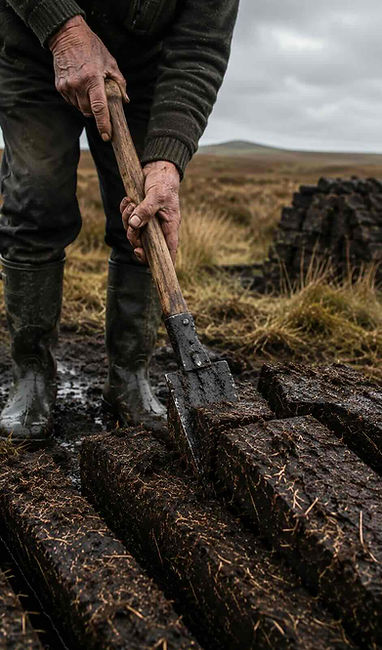
Long before anyone spoke about phenols, carbon storage or sustainability, people burned peat because it was practical.
Whisky production begins with barley. During malting, the grain is soaked in water and allowed to germinate, activating enzymes that convert starch into fermentable sugars. Before the growing barley consumes those sugars, germination must be halted by drying the grain.
Throughout history, maltsters simply used whatever fuel was readily available. In many parts of Europe this meant wood. Elsewhere it might have been coal or other local fuels.
Scotland, however, offered something different.
More than one fifth of the country's land is covered by peatlands, vast landscapes formed over thousands of years as layers of vegetation slowly accumulated in waterlogged conditions. ¹ Rich in stored organic material and naturally slow to decompose, peat became an abundant, reliable and inexpensive source of fuel for generations of Scottish communities. For distillers, burning peat was never about creating a fashionable flavour. It was simply the fuel that the landscape provided. Only later did they realise it produced something unique.
.
What began as necessity eventually became identity. Smoke that once simply dried Scotland's barley would come to define some of its most celebrated whiskies.

Smoke That Survives the Journey
As peat burns, it releases an incredibly complex mixture of smoke containing hundreds of aromatic compounds. Among the most important are a family of chemicals known as phenols, which become absorbed into the damp malted barley as smoke passes through the kiln.²
Those compounds begin an extraordinary journey.
Despite fermentation, distillation and years spent maturing inside oak casks, a proportion of these phenols survive all the way into the finished whisky. They become responsible for many of the aromas and flavours associated with peated whisky: smoke, ash, earth, iodine, sea spray and medicinal notes.²
You can even coax a little more of that smoke from the whisky once it's in your glass. Adding a small amount of water has been shown to bring guaiacol—one of the compounds associated with peat smoke—closer to the surface of the liquid, where its aroma is easier to detect. It's one reason a few drops of water can sometimes make a peated whisky seem more expressive.³
There is a limit, though. Further dilution eventually begins to suppress rather than reveal the whisky's aromas, making individual flavours harder to distinguish. A little water can open the glass; too much can begin to flatten it.⁴


Every Peat Bog Tells a Different Story
Not all peat is created equal.
Unlike coal, which forms over millions of years under immense geological pressure, peat reflects the landscape in which it developed. Its composition is influenced by thousands of years of local vegetation, climate, water conditions and natural decomposition.
Because every peatland develops differently, the smoke produced from burning peat can also vary. While researchers are still exploring exactly how these differences influence flavour, studies have identified geographical differences in the chemical composition of peat and the smoke it produces.⁵
In many ways, peat carries the fingerprint of the landscape from which it came.
More Than Smoke
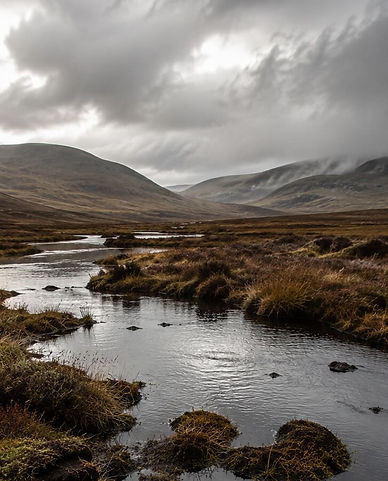
Ironically, the qualities that made peat so useful to distillers are the same qualities that now make it globally significant. Although peatlands cover only around 3% of the Earth's land surface, they store more carbon than all the world's forests combined.⁶ Acting like enormous natural sponges, they absorb rainfall, reduce flooding and naturally filter water before it reaches rivers and streams. They also provide habitat for countless specialised plants and animals.⁶
These ecosystems develop at an astonishingly slow pace. Peat typically accumulates at around one millimetre each year, meaning a metre-deep peat bog may represent roughly a thousand years of natural history.⁷ When peatlands are drained or harvested, oxygen reaches material that has remained preserved for centuries. As decomposition accelerates, stored carbon is released back into the atmosphere, transforming one of nature's greatest carbon stores into a source of emissions.⁶ It is this transformation—not whisky itself—that has placed peatlands firmly within the global environmental conversation.
Tradition Meets a Changing World
The whisky industry is far from ignoring the issue. Major producers have committed millions of dollars towards restoring damaged peatlands across Scotland, recognising that protecting these landscapes is essential not only for biodiversity but also for the future of Scotch whisky itself. Companies including Diageo and Suntory Global Spirits have invested in large-scale restoration projects alongside broader sustainability commitments aimed at reducing their environmental footprint.⁸ ⁹
Some distilleries are also rethinking how peat is used during production. Rather than treating peat as an essential ingredient in every expression, producers are beginning to reserve it for whiskies where smoke forms a core part of the intended character. One of the most notable examples is The Glenturret. Long recognised for producing lightly peated Highland whiskies, the distillery has removed peat from its core range, choosing instead to focus on unpeated expressions that better reflect its contemporary house style. While the decision was driven by more than sustainability alone, it illustrates how production philosophies continue to evolve.¹⁰
Elsewhere, researchers and producers are investigating alternative approaches to creating smoke and using peat more efficiently, recognising that preserving peat may ultimately require reducing dependence on it.
While Scotland remains synonymous with peated whisky, producers elsewhere are experimenting with different ways of introducing smoke. Tasmania's LARK distillery takes an unusual approach. Rather than using peat to dry the barley during malting, the distillery begins with already malted grain and introduces peat smoke afterwards. LARK says this post-malt smoking process gives its distillers greater control over the intensity of the peat influence, allowing smoke to become another layer of flavour rather than overwhelming the character of the spirit.¹¹ It is one example of how producers are beginning to reconsider a centuries-old process—raising the possibility that the future of peated whisky may involve changing not just where peat comes from, but how it is used. The question is no longer whether sustainability matters.
It is how the industry preserves a flavour that has become synonymous with its heritage.
The Future of Smoke
Perhaps the most fascinating question is one that science cannot answer on its own. If researchers eventually recreate the aromatic profile found in traditional peat smoke using more sustainable alternatives, would the resulting whisky still be considered authentically peated?
Chemically, perhaps.
Emotionally, many enthusiasts might disagree. After all, part of peat's appeal has always been its connection to place. Every smoky whisky carries with it the story of ancient landscapes, local traditions and generations of distillers working with the materials available to them. That story cannot be engineered quite so easily.

Looking Ahead
For centuries, peat has been more than a fuel. It has shaped the identity of some of the world's most distinctive whiskies and connected the character of the spirit directly to the landscape from which it came. Today, those same landscapes are valued not only for the flavours they create, but for the role they play in protecting our environment.
The future of peated whisky is unlikely to be defined by a single decision or scientific breakthrough. Instead, it will be shaped by countless choices made by distillers, researchers, policymakers and consumers alike. Whether that future looks exactly like the past remains uncertain.
What seems far more likely is that every smoky glass will continue to tell a story—one that begins not in the distillery, but in an ancient peat bog that has been quietly shaping both Scotland's landscape and its whisky for thousands of years.
References & Further Reading