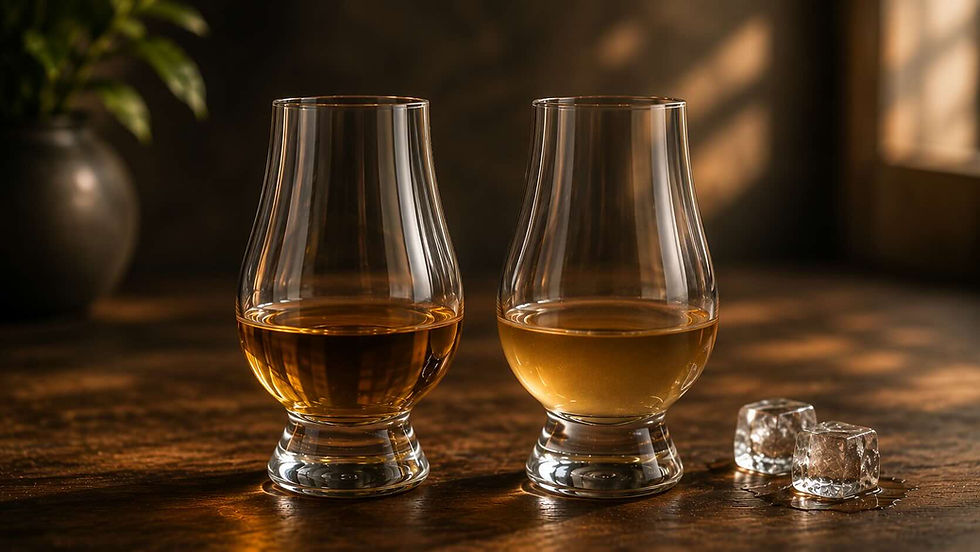
Does the Glass Really Matter?

Why the glass you drink whisky from changes the experience
Pour the same whisky into a tumbler and a Glencairn and, technically, nothing about the whisky has changed. Same liquid. Same ABV. Same cask maturation. Yet it can smell — and even seem to taste — surprisingly different. Whisky glassware can easily drift into the more pretentious corners of the hobby, where the shape of a piece of glass starts sounding almost as important as what is inside it. But there is a genuine reason different glasses produce different experiences. Most of it comes down to your nose.
Much of what we call flavour is actually aroma
When you drink whisky, your tongue is doing less work than you might think. It can detect the basic tastes — sweetness, bitterness, acidity and so on — but much of the detail we associate with flavour comes from aroma. Vanilla, dried fruit, smoke, leather, citrus, honey and spices are largely being identified by the olfactory system. That happens before you take a sip, when you nose the whisky, but also while it is in your mouth. Aromatic compounds travel from the back of the mouth into the nasal cavity, a process known as retronasal olfaction. This is why whisky can seem remarkably dull when you have a blocked nose. And it is where the glass starts to matter.
What the shape of the glass actually does
A wide glass gives the volatile aromatic compounds escaping from the whisky plenty of room to disperse. A glass that narrows towards the top does the opposite. Its wider bowl gives the whisky surface area to release those compounds, while the narrower opening helps concentrate them near your nose. That simple idea sits behind most dedicated whisky tasting glasses. It doesn't create aromas that weren't already there. It simply makes some of them easier to detect. There is another consideration: alcohol.
Ethanol is volatile too, and pushing your nose deep into a glass of cask-strength whisky can demonstrate that rather efficiently. Glass design is therefore a balance between concentrating the whisky's aromas and delivering a concentrated hit of alcohol.
The Glencairn: the modern whisky standard
If there is one glass now associated with whisky tasting, it is the Glencairn. The glass was conceived by Scottish glassmaker Raymond Davidson, who wanted to create a purpose-built whisky glass that combined the nosing qualities of traditional tasting glasses with something more practical to hold and use. His original design was later refined with input from figures in the Scotch whisky industry, and the Glencairn Glass was launched in 2001.
Its shape combines a broad lower bowl with sides that taper towards a relatively narrow rim. It allows you to swirl the whisky easily, gives the liquid room to release aromas and then directs those aromas towards the nose. It also happens to be practical. The solid base makes it considerably less delicate than traditional stemmed tasting glasses, and its size works well for the relatively small pours normally used when drinking whisky neat.
For someone trying to identify individual aromas or compare several whiskies, there is a reason the Glencairn has become so common. It works.
What about a copita?
The Glencairn wasn't the first glass to use this principle. The copita — a small, stemmed, tulip-shaped glass traditionally associated with sherry — has long been used for nosing spirits. Its bulbous body and narrow opening perform much the same job: allowing aromas to develop before concentrating them towards the nose. For deliberate tasting, a good copita can be excellent.
The stem also lets you hold the glass without warming the bowl as much with your hand, although whether that makes a meaningful difference during a normal whisky session is another question entirely. Its biggest disadvantage is probably practicality. A Glencairn is sturdy, easy to hold and difficult to knock over. A delicate stemmed copita feels more at home at a tasting table than beside the couch.
And the humble tumbler?
The traditional whisky tumbler — or rocks glass — isn't suddenly a bad whisky glass. It is simply designed for a different job. Its wide opening doesn't concentrate aromas as effectively, so some of the finer details of a whisky may be harder to pick out. If you're sitting down specifically to analyse a new bottle, it probably wouldn't be our first choice. But add a large cube of ice and the tumbler makes considerably more sense. The same applies to whisky cocktails, highballs that use a suitable taller glass, or simply having a relaxed pour without trying to identify whether that distant fruit note is a fig or a raisin.
There is something to be said for a glass that feels good in your hand. Not every whisky needs to be studied.
Does whisky actually taste better from a Glencairn?
Potentially — but that's not quite the right way to think about it. The glass hasn't improved the whisky. What it can improve is your ability to perceive it. If a whisky has subtle fruit, spice or cask-derived aromas, concentrating those compounds can make them easier to recognise. Because smell contributes so heavily to flavour, that can make the entire whisky seem richer or more complex.
Try it yourself. Pour a small amount of the same whisky into a tumbler and a Glencairn or other tulip-shaped glass. Leave them for a few minutes, then smell them side by side.
You don't need to search for obscure tasting notes. Just ask a simpler question:
Do they smell the same? For many whiskies, the difference is surprisingly easy to notice.
So which whisky glass should you buy?
If you drink whisky neat and want one dedicated glass, the Glencairn is difficult to argue against. It is inexpensive, durable and genuinely useful for exploring aroma. If you enjoy more deliberate tastings, a copita or another tulip-shaped tasting glass is worth experimenting with. And if you prefer whisky over ice in a heavy tumbler, keep using the tumbler. The purpose of specialist glassware isn't to establish a correct way to drink whisky. It is simply another tool that can reveal a little more of what is already in the glass.
Sometimes that matters. Sometimes you just want a whisky.
Learn more: To understand the journey from grain to glass, explore our Foundation guide, How Whisky Is Made.