Johnnie Walker: Great Whisky or Great Marketing?
How the world’s most recognisable Scotch built its reputation—and what remains once the branding is stripped away.
Johnnie Walker is one of the most recognisable names in whisky. Its success is inseparable from brilliant marketing-but behind the colours, gift boxes and limited-edition designs sits an enormous whisky-making operation and a level of blending skill that is easy to overlook. The question is not whether Johnnie Walker is great whisky or great marketing. It is where one ends and the other begins.
Walk into an airport duty-free store almost anywhere in the world and Johnnie Walker will already be waiting for you. The square bottle, diagonal label and striding figure require almost no introduction. Even someone who knows little about whisky understands that Black is respectable, Gold is more luxurious and Blue is intended to signify arrival. Johnnie Walker has made a complicated drink remarkably easy to navigate. That simplicity is one of the greatest achievements in drinks marketing. It is also part of the reason many whisky enthusiasts distrust the brand. To them, Johnnie Walker can represent almost everything modern whisky culture has learned to question: enormous production, added colour, chill filtration, widespread bottling at 40% ABV and a hierarchy in which price and presentation can appear more important than what is actually in the glass. Blue Label, in particular, now arrives in a seemingly endless succession of artist collaborations, city editions and commemorative designs.
It is tempting, then, to dismiss the whole operation as marketing. That would be too easy. Johnnie Walker is not merely a famous label placed on ordinary whisky. Diageo describes it as the world's best-selling Scotch, enjoyed in more than 180 countries. A brand does not reach that position-and remain there-without understanding both people and whisky
exceptionally well.
A marketing story built on whisky
Johnnie Walker did not become a global brand through the liquid alone. Some of its most recognisable marketing features began as practical commercial decisions. The square bottle was practical: easier to pack for export and less likely to break at sea. The angled label made it immediately distinguishable from the bottles around it. Then, in 1908, the Striding Man turned a family name into a character defined by movement and momentum. These were clever decisions, but not empty ones. Johnnie Walker's early growth depended on a product that could travel and remain dependable. Blending was not a compromise made because single malt was unavailable. It was the method by which a recognisable house style could be created.
That principle still sits at the centre of Johnnie Walker. The difference is the scale. Diageo owns one of the largest collections of Scotch whisky distilleries and maturing stocks in the industry. Its portfolio includes names such as Cardhu, Caol Ila, Clynelish, Talisker and many others, as well as the grain whisky required for its major blends. For the Johnnie Walker blending team, this is an extraordinary palette. A small independent producer might build a whisky from a limited number of parcels. Johnnie Walker can draw on spirit from different regions, distilleries, cask types and years of production, then use those components to maintain a flavour that consumers recognise across markets and across decades. Scale alone cannot guarantee great whisky. It does make the idea that Johnnie Walker is only a marketing creation difficult to sustain.

The achievement hidden inside Black Label
Black Label may be the most convincing argument in Johnnie Walker's favour. It is easy to overlook because it is everywhere. Familiarity can make a whisky seem less interesting, particularly in a culture that constantly rewards rarity, new releases and obscure distilleries. Yet Black Label remains a 12-year-old blended Scotch with enough fruit, sweetness, malt, smoke and oak to provide genuine complexity, while remaining approachable to someone who does not spend their time analysing whisky.
It is also made in immense volume. That matters. Creating one exceptional cask is partly an act of selection. Recreating a recognisable blend year after year from an evolving inventory is a different kind of skill. Each batch must return to roughly the same destination even though no two casks are identical. It must work neat, over ice, with water or in a highball. It must satisfy drinkers who know the flavour intimately while remaining accessible to those encountering Scotch for the first time. Black Label is not presented as whisky in its most uncompromised form. It is presented as dependable whisky for a very broad audience. On those terms, it succeeds remarkably well. For the money, it remains one of the strongest bottles in the range.
Whisky enthusiasts sometimes speak of blends as though the addition of grain whisky automatically makes them inferior to single malts. That misunderstands the category. Grain whisky can provide lightness, sweetness and structure, while malts bring flavour and character. The quality of the result depends on the quality of the components, their proportions and the judgement used to combine them. Single malt tells the story of one distillery. A blend can tell the story of an entire inventory.

Designed for almost everyone
The qualities that make Johnnie Walker commercially formidable are also those most likely to frustrate whisky enthusiasts. Many of Johnnie Walker’s best-known expressions are bottled at 40% ABV the legal minimum for Scotch whisky—although strength varies by market and release. At this relatively restrained strength, the whisky is approachable to a broad audience and versatile enough to serve neat, over ice, in a highball or as a mixer. It also produces more bottles from the available mature whisky, a considerable commercial advantage at Johnnie Walker’s scale. The trade-off is intensity. A higher bottling strength can carry more aroma, texture and flavour. It also gives the drinker the choice of whether—and how far-to dilute it. At 40%, that choice has largely been made before the bottle is opened.
The same tension applies to appearance. Johnnie Walker's mainstream blends are produced to look stable and consistent, using processes that include chill filtration and permitted spirit caramel colouring. Chill filtration helps prevent haze when whisky becomes cold or is diluted. Caramel colouring allows different batches to maintain a familiar shade despite natural variation between casks. From the perspective of a global brand, both decisions make sense. Wherever it is sold, Johnnie Walker is expected to look and taste the same. A customer should not mistake harmless cloudiness for a fault, and a slightly lighter batch should not appear less mature than the bottle beside it.
From the enthusiast's perspective, those same decisions can feel like needless intervention. Many whisky drinkers now actively seek the words natural colour, non-chill-filtered and 46% ABV. These details have become shorthand for a producer allowing whisky to present itself with less cosmetic adjustment and more of its original texture intact. Johnnie Walker generally follows the opposite philosophy: consistency before variation, clarity before texture and accessibility before maximum intensity. These choices reveal more about Johnnie Walker's priorities than they do about quality. Caramel colouring is primarily used for appearance, and the exact sensory effect of chill filtration remains debated. What is clear is the intended audience: not the narrowest circle of enthusiasts, but the widest possible group of drinkers.
Its greatest strength and greatest weakness may therefore be the same: it is engineered to appeal to almost everyone.
The logic of the colour ladder
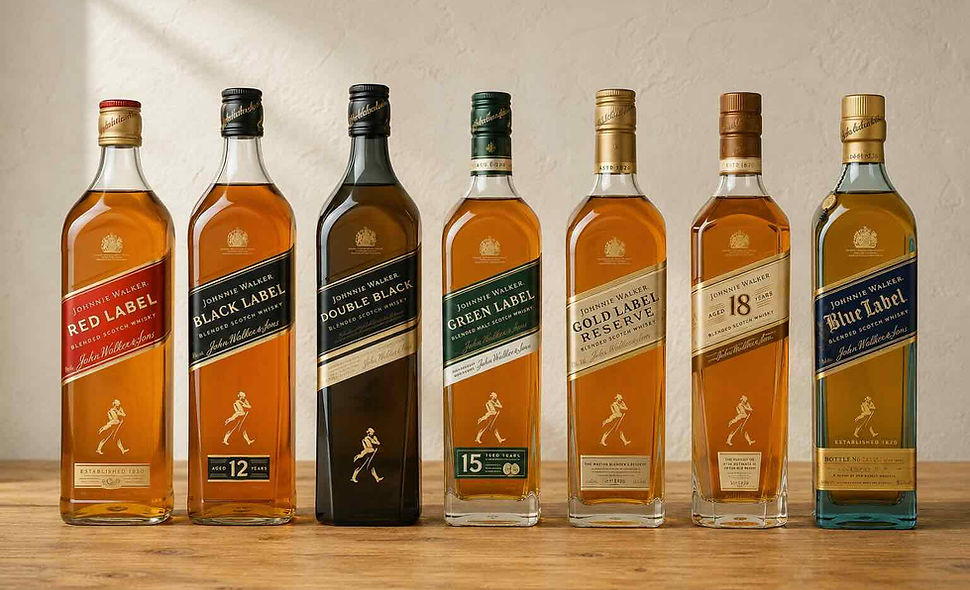
Johnnie Walker's colour system is brilliantly intuitive, although the range is more carefully constructed than a simple climb from inexpensive to expensive. It covers different flavours, prices and occasions while creating an easily understood path upward. A customer does not need to know the difference between Speyside and Islay, malt and grain, or bourbon and sherry casks. The colours do most of the work. Johnnie Walker’s range is now broader than its familiar colour ladder, with new expressions and market-specific releases regularly appearing. But the best-known labels still reveal how the system works.
Red Label provides the entry point. It is primarily built for mixing and, in my view, is a fairly ordinary whisky—but its price reflects that position. Black Label is where the range becomes genuinely interesting: the 12-year-old benchmark and, in my view, the range's strongest value. Double Black takes that familiar structure in a darker and smokier direction rather than simply moving it another step upward. Green Label is the anomaly—and one of the most interesting bottles Johnnie Walker makes. It began life as Johnnie Walker Pure Malt 15 Year Old before becoming Green Label, and is now correctly described as a blended malt: a combination of single malt whiskies from different distilleries, with no grain whisky included. Its age statement, malt-only construction and more distinct character make it the expression most naturally aligned with enthusiast preferences.
Green's significance lies in its different construction, not in any assumption that malt must be superior to grain. Such an assumption would undermine the blending skill that Black Label demonstrates so well. Green shows another side of Johnnie Walker: less concerned with seamless universality and more willing to let individual malt character remain visible.
Its history is also revealing. Green Label was withdrawn from most markets during Johnnie Walker's early-2010s restructuring, then returned to the global range several years later. Johnnie Walker had removed perhaps its most enthusiast-friendly core bottle, only to discover that demand for it had not disappeared. Above these sit Gold Label Reserve, Johnnie Walker Aged 18 Years and Blue Label. Gold offers a softer, sweeter and more celebratory style. The 18-year-old supplies a clear statement of maturity. Blue occupies the prestige position, presented less as an everyday whisky and more as an event. This kind of progression is normal; every producer positions bottles at different price points. Johnnie Walker simply does it more clearly than almost anyone else. The complication is that the overall hierarchy encourages us to read price as quality. Moving upward feels like moving toward better whisky, even when Double Black and Green demonstrate that some expressions are pursuing different constructions or flavours—or when the additional cost is increasingly paying for rarity claims, packaging and status.
Gold Label Reserve occupies an interesting middle ground. It feels more luxurious than Black Label and remains relatively attainable. Its honeyed, polished style suits the role Johnnie Walker has created for it: not necessarily a whisky to analyse for an evening, but one that communicates celebration without reaching Blue Label pricing.
How Gold changed without disappearing
Gold reveals just how flexible the meaning of a colour can be. The former Gold Label—The Centenary Blend—carried an 18-year age statement and was, in my view, a considerably better whisky than today's Gold Label Reserve. It drew its identity from a blend associated with the Walker company's hundredth anniversary, although most drinkers probably remember it simply as Gold Label 18. The early-2010s restructuring introduced Gold Label Reserve and Platinum Label while the former Gold Label 18 gradually disappeared from many markets. The qualities represented by the old bottle were effectively separated. Gold Label Reserve retained the familiar colour and its association with celebration but lost the age statement. Platinum Label occupied the 18-year position further up the hierarchy; its place was later taken by Johnnie Walker Aged 18 Years. Gold therefore remained Gold, but the whisky represented by that colour had changed. For the casual buyer, the visual hierarchy survived intact. For anyone who remembered the original Gold Label 18, the difference was much more substantial. The colour proved more durable than the specification.
Blue Label: excellent whisky at a difficult price
Blue Label is where Johnnie Walker's two great abilities-blending whisky and building prestige-become almost impossible to separate. In the glass, it is polished, layered and remarkably composed. Nothing dominates: sweetness, fruit, oak and restrained smoke arrive as parts of a deliberately seamless whole. It is probably my favourite whisky in the regular Johnnie Walker range. Yet Blue Label is sold as more than a blend. The weight of the bottle, the presentation box, the language of rarity and the familiarity of the blue diagonal label all contribute to the experience before it is tasted. That makes judging its value unusually difficult.
The whisky itself is excellent. Its price is harder to defend, largely because of what else the same money can buy. At a similar cost, drinkers can choose age-stated single malts, higher-strength releases, independently bottled whiskies and expressions that provide far more information about their production. Against those alternatives, a 40% ABV, no-age-statement whisky presented without the enthusiast signals of natural colour or non-chill filtration becomes difficult to defend on liquid value alone. Liquid value is only part of what Blue Label offers. As a gift, it is unusually effective. The recipient recognises it immediately. The box feels substantial. The bottle communicates generosity without requiring an explanation. Give someone an obscure but exceptional single malt and you may need to explain why it matters. Give them Blue Label and the message arrives before the bottle is opened. That recognition carries real value, created by decades of brand building rather than flavour alone. Blue Label can therefore be both overpriced and entirely appropriate. It can lose a blind value comparison while winning the moment for which it was purchased.
When the bottle becomes the product
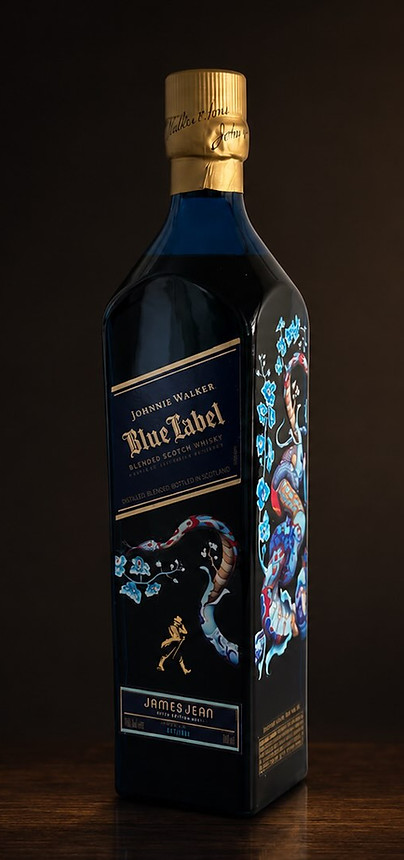
Few whiskies demonstrate the power of presentation as clearly as Blue Label. Over the years, the familiar blend has appeared in city editions, Lunar New Year releases, artist collaborations and numerous limited-edition designs. In many cases, the distinction is the artwork surrounding the established Blue Label whisky rather than a fundamentally new
liquid. The artwork may be limited. The whisky inside often is not. The strategy is commercially astute. A new design gives an established product freshness without asking consumers to learn a new whisky. It turns the bottle into a souvenir, a cultural object or a display piece. It gives existing customers another reason to buy something they already know. An artist-edition Blue Label makes this visible. Its usefulness in this discussion is not that the design lacks merit-it may be beautiful-but that the design changes how the bottle is perceived. The liquid gains a new setting, a new story and perhaps a new sense of scarcity, even when the underlying blend remains the familiar Blue Label.
This is Johnnie Walker functioning as a luxury house rather than merely a whisky producer. The brand's 200th anniversary shows the difference between a new presentation and a new whisky. It produced both special designs and genuinely distinct blends. The John Walker & Sons Celebratory Blend, presented in a striking white box and bottled at 51% ABV, drew inspiration from the Walker family's nineteenth-century Old Highland Whisky. The far more expensive Bicentenary Blend was a separate 28-year-old whisky bottled at 46% ABV. Sometimes Johnnie Walker uses heritage to repackage an established product. At other times, heritage becomes permission to depart from the safe, 40% model. These less conventional releases reveal what the brand can do when broad accessibility is no longer the first requirement.
Single malt tells the story of one distillery. A blend can tell the story of an entire inventory.
The enthusiast's blind spot
Whisky enthusiasts are right to ask difficult questions of Johnnie Walker. At the premium end, 40% ABV can feel unnecessarily cautious. Added colour makes it harder to read the whisky's natural appearance. Chill filtration prioritises visual stability over a less processed presentation. Constant redesigns can make the packaging appear more dynamic than the liquid. Blue Label's price undeniably includes the cost—and value—of its name. Enthusiasts bring biases of their own. Limited availability can be mistaken for quality. Cask strength can be treated as inherently superior even when balance suffers. A natural colour statement can generate approval before the whisky is tasted. Single malt can receive respect simply for being single malt, while a carefully assembled blend is dismissed because it is familiar and contains grain whisky.
Johnnie Walker exposes that contradiction. If whisky should ultimately be judged in the glass, it cannot be rejected solely because it is popular, blended or presented for a mainstream audience. Black Label should not be excused because it is inexpensive. It deserves recognition because it offers balance and complexity that many more expensive whiskies fail to achieve. Judged purely by what is in the glass, it does not merely compete at its price; it frequently punches well above it. Blue Label deserves to be judged both as whisky and as a luxury product, because that is what it has deliberately become. The conclusions need not be the same.
There is also something faintly contradictory about criticising Johnnie Walker for understanding its customer too well. Many people do want whisky that is smooth, consistent and easy to share. They do care whether a gift is recognisable. They may prefer a bottle that does not cloud over ice and may have no interest in why 46% ABV matters to enthusiasts. Johnnie Walker serves those people exceptionally well.

Great whisky or great marketing?
Johnnie Walker could not have become the dominant name it is through marketing alone. The marketing is exceptional: the square bottle, angled label, Striding Man, colour hierarchy, gift boxes and limited editions form one of the most coherent identities in the drinks world. Johnnie Walker has made Scotch understandable in places where its regions, rules and traditions might otherwise seem impenetrable. But the brand's success rests on genuine whisky infrastructure and expertise. Diageo's vast reserves give its blenders possibilities few producers can match. Black Label demonstrates the ability to create complexity, consistency and value on an extraordinary scale. Blue Label demonstrates how seamless and refined blending can become.
The criticism is not that the whisky is an illusion. It is that the whisky increasingly shares the stage with something else. Johnnie Walker controls colour, clarity and strength to produce a dependable global product. It organises the range into an easily understood ladder. At the top, it repeatedly renews familiar liquid through luxury packaging, art and occasion. Each decision is rational. Together, they create a brand in which the experience begins long before the first sip-and in which part of the price pays for what the bottle means to other people.
Perhaps that is the fairest way to understand Johnnie Walker. It is neither a triumph of marketing disguising mediocre whisky nor a misunderstood masterpiece unfairly rejected by enthusiasts. It is an exceptionally skilled whisky operation shaped, polished and sometimes constrained by an even more powerful brand.
Black Label shows why Johnnie Walker earned its reputation. Blue Label shows what that reputation is now worth. And the higher we climb through the colours, the harder it becomes to tell where the whisky ends and the marketing begins.